
St. Charles Parish Court Records After a Jail Arrest
In St. Charles Parish, a person arrested by the Sheriff's Office, Louisiana State Police, a federal agency, or another holding authority is booked at Nelson Coleman Correctional Center when local custody is involved. The jail record may show the arrest date, mugshot, age, race, sex, and hold-reason text in the public Zuercher roster at https://stcharles-so-la.zuercherportal.com/#/inmates. Court records after a jail arrest move through different offices: the 29th Judicial District Court, the St. Charles Parish Clerk of Court, and the 29th Judicial District Attorney.
The booking side helps confirm that someone entered custody, but it should not be treated as the final charge record. The jail inmate records page is the better place to read the current roster, agency holds, and custody status. The jail mugshots page explains booking photos and photo-copy requests. For filed criminal charges, dispositions, pleas, court dates, and sentencing, use the court and prosecutor channels described below.
The 29th Judicial District Court states that it has original jurisdiction over criminal, civil, and juvenile matters in St. Charles Parish. The District Attorney, Joel T. Chaisson, II, decides what prosecution to file after arrest review. The Clerk of Court is the court-records custodian for case records, while the Sheriff's Criminal Records Division manages arrest files and warrants or attachments generated by the court.
How to Find Court Records After an Arrest
Start with the office that owns the record you need. Current custody and booking information are in the Nelson Coleman roster. Filed criminal cases should be checked through the Clerk of Court's public records search or Clerk office, and prosecutor-held materials should be requested from the District Attorney when they are not exempt. The Clerk public search page at https://www.scpclerkofcourt.com/clerk-of-court/public-records-search/ existed during research, but it returned a JavaScript or verification block in a text browser. That limitation makes the phone, mail, and in-person fallback important.
- Check the current custody record in the St. Charles Parish Zuercher roster if the arrest may be recent.
- Use the Clerk's public records search or call the St. Charles Parish Clerk of Court at (985) 783-6632 with the defendant name, case number if known, and approximate filing date.
- Open the criminal case record and compare every filed charge with the jail roster's hold-reason text.
- Read the status of each charge separately because one count may be pending, another amended, and another dismissed.
Louisiana VINE at https://vinelink.vineapps.com/state/LA is a custody-status and notification channel, not a complete court docket. DPS&C also provides a phone locator at (225) 383-4580 for state custody. If a roster entry says USMS, BOP, ICE, DOC, fugitive hold, or another parish agency, the court record may not be limited to St. Charles Parish.
Limited Court Search Channels and Fallbacks
St. Charles Parish court-record access is narrower than a simple statewide criminal portal. The parish public-records guidance routes court and vital records to the Clerk of Court, not the parish JustFOIA portal. Clerk Connect may support civil, criminal, land, and property inquiries for participating Louisiana clerks, but St. Charles-specific access details were not fully exposed during research.
| Channel | Best Use | Limits to Check |
|---|---|---|
| Clerk public records search | Case lookup where browser access works | Verification or JavaScript block may prevent access in some browsers |
| Clerk Connect | Subscription-style Louisiana clerk inquiry where supported | Account, office participation, and record type coverage must be confirmed |
| Clerk office request | Case copies, docket entries, and certified records | Use case number or defendant name; call (985) 783-6632 |
| DA public-records request | Records in the prosecutor's custody | Pending prosecution, investigative material, and privileged work product may be exempt |
The District Attorney homepage at https://www.stcharlesda.com/ identifies Joel T. Chaisson, II as District Attorney and lists the office at 15045 LA 18, Hahnville. The captured DA homepage is useful because it shows the local prosecuting office, hours, address, and phone in one place.
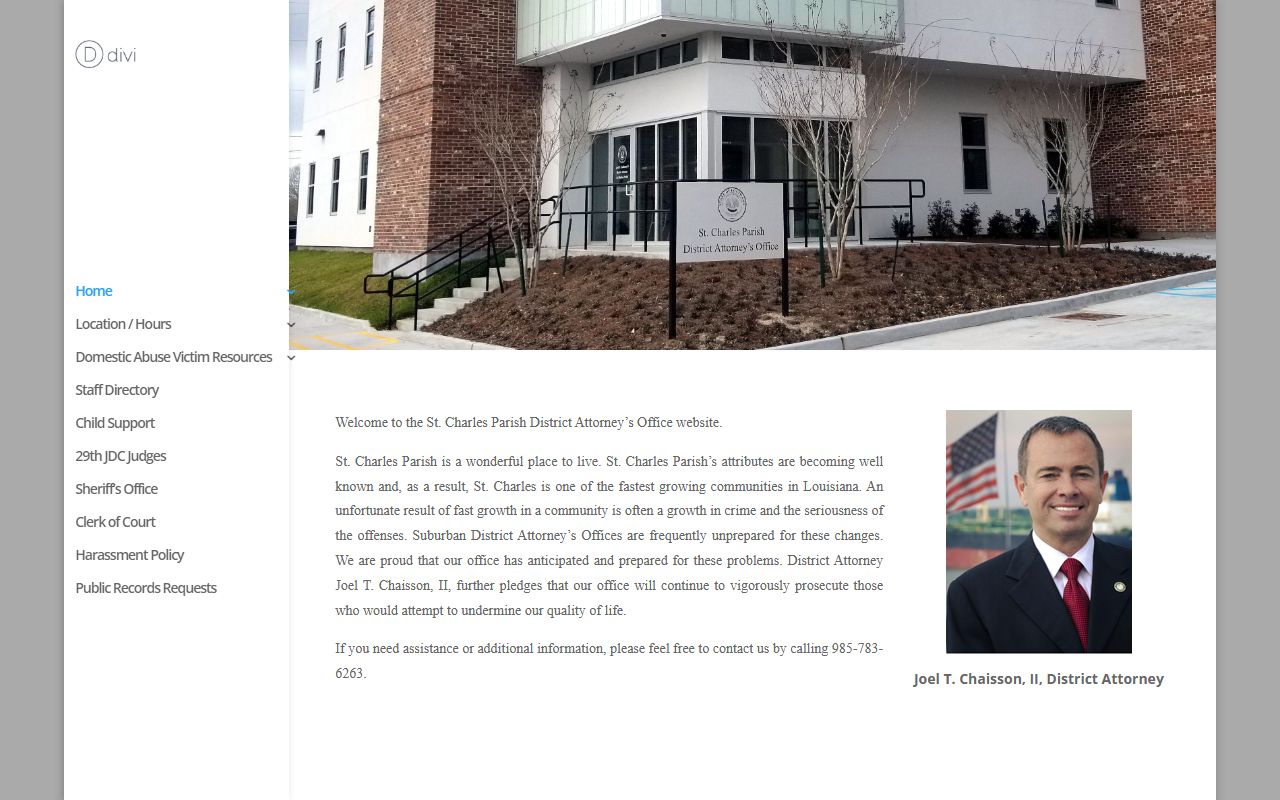
Use the DA contact for prosecutor-held records and charging questions, but use the Clerk for court-file copies and the jail for custody or release questions.
How Charges Get Filed After an Arrest: Complaint, Information, and Indictment
Booking charges are intake information. Filed court charges are created when a charging document is filed or a grand jury returns an indictment. In Louisiana practice, the charging route depends on the offense, the prosecutor's decision, and any grand-jury requirement. A defendant can appear on the jail roster before the final court charge list is available, and the final filed charges can differ from what appeared at booking.
| Complaint | Information | Indictment | |
|---|---|---|---|
| Usually Filed By | Law enforcement or prosecutor, depending on stage | District Attorney | Grand jury |
| Common Use | Initial accusation or misdemeanor pathway | Many felony prosecutions after DA review | Serious felony matters requiring or using grand-jury action |
| What It Starts | Court process tied to the accusation | Filed criminal case or filed count | Criminal prosecution on indicted count |
| What to Compare | Arrest summary and initial booking text | Filed charge, statute, count, and date | Indicted offense and later amendments |
Article 701 Filing Deadlines After Arrest
Louisiana Code of Criminal Procedure art. 701 sets prosecution-filing deadlines after arrest. When the defendant remains in custody, the filing period is generally 30 days for a misdemeanor, 60 days for a felony, and 120 days for a felony punishable by death or life imprisonment, subject to the article's hearing rules and exceptions. When the person is not in custody, the general filing periods are longer: 90 days for a misdemeanor booking and 150 days for a felony booking.
Those deadlines are not a promise that every person will be released on a calendar date. Holds, warrants, DOC custody, federal custody, and court rulings can change the practical result. The key use for St. Charles Parish court records after arrest is to see whether the DA filed a bill of information, indictment, or other charging action, and whether the court entered any release, dismissal, or bond order tied to Article 701.
Charge Status in Court Records After Arrest
Charges can change after the initial jail arrest. The DA may file different counts, amend an offense, reduce a charge, add a count, dismiss a count, or enter nolle prosequi. A public reader should compare the court record with the roster's hold reason rather than treating the first booking text as the outcome.
| Status | What It Means |
|---|---|
| Pending | The charge remains active and has not reached final disposition. |
| Filed | The prosecutor has placed the charge into the court record through a charging document. |
| Amended / Reduced | The filed charge changed, often to a different count, level, or statutory citation. |
| Dismissed | The court record reflects that the count was ended by court action or prosecutor request. |
| Nolle Prosequi | The prosecutor declined to continue prosecution on that charge. |
| Convicted / Plea | The charge resulted in a verdict or guilty/no-contest plea and may move to sentencing. |
Bond and Release After an Arrest
Bond information may appear in the jail roster's hold-reason text rather than a clean bond column. St. Charles samples included language such as "Bond - No Bond, $0.00; Set By No Bond." Bond may be set after a first appearance, warrant review, or other court action. The Sheriff's corrections page confirms video arraignment exists at Nelson Coleman, which can reduce transport to court.
| Bond Type | How It Works |
|---|---|
| Cash Bond | Full amount paid directly if the court or jail accepts that form; verify amount and recipient before travel. |
| Surety Bond | A licensed bondsman guarantees appearance; the bondsman's fee is separate and usually nonrefundable. |
| PR / Own Recognizance | The court authorizes release on promise and conditions without upfront cash. |
| No-Bond Hold | Release is blocked until the court or holding authority changes the status. |
| Agency Hold | DOC, USMS, ICE, another parish, or a warrant hold may block release even when a local bond exists. |
Bond scam warning: The 29th JDC has posted arrest, bail, and bond scam alerts. Verify payment instructions with Nelson Coleman, the court, or counsel before sending money.
Warrants That Lead to an Arrest
The Sheriff has a warrants page at https://www.stcharlessheriff.org/282/Warrants, but no public active-warrant search database was located. The Warrants section oversees active warrants in conjunction with the Parish Correctional Center and enforcement divisions. The Criminal Records Division manages arrest warrants and attachment files generated by the 29th JDC, and Special Operations handles fugitive apprehension and arrest-warrant tracking.
Common warrant categories include arrest warrants, bench warrants or attachments for failure to appear or contempt, fugitive warrants from another jurisdiction, search warrants, and probation or parole holds. If a warrant led to jail booking, the Nelson Coleman roster may show a fugitive hold, DOC parole hold, another parish agency, USMS, ICE, or no-bond language. For warrant questions, call the Sheriff's Office at (985) 783-6237, contact the Clerk at (985) 783-6632, or consult an attorney before appearing in person.
Charges vs. Convictions
An arrest and a charge are not the same as a conviction. Louisiana public records may show that a person was booked or charged, but guilt is not established unless the case ends in a plea or verdict. That distinction matters for employment, housing, licensing, and reputation, and it is one reason court records after a jail arrest should be read count by count.
| Charge | Conviction | |
|---|---|---|
| Stage | Accusation filed or carried forward after arrest | Final result through plea or verdict |
| Proof Level | Probable cause or prosecutor charging decision | Beyond a reasonable doubt or accepted plea |
| Record Meaning | Shows what was alleged or prosecuted | Shows legal responsibility for the offense |
| Possible Later Change | Can be amended, reduced, dismissed, or nolle prossed | Can be appealed, set aside, pardoned, or become expungement-relevant if eligible |
Sealed vs. Expunged Arrest Records
Louisiana uses expungement language for many record-clearing situations. The research source notes that expungement is removal from public access, not physical destruction of every government trace. Louisiana Code of Criminal Procedure art. 989 provides expungement motion language and ties eligibility to the broader expungement articles. A dismissed charge, acquittal, non-prosecution, pardon, or vacatur may also matter for booking-photo removal rights under art. 234 when a remove-for-pay website is involved.
| Sealed / Restricted | Expunged in Louisiana | |
|---|---|---|
| Public Visibility | Hidden or withheld from ordinary public access | Removed from public access if the court grants the expungement |
| Government Access | May remain available to courts or law enforcement under law | Not treated as complete physical destruction of all records |
| Typical Trigger | Juvenile matter, protected victim information, sealed order, or exempt material | Eligible dismissal, acquittal, non-prosecution, or other qualifying disposition |
| Where to Confirm | Clerk of Court and originating agency | Clerk of Court, court order, and agency compliance |
DA Public Records Fees and Exemptions
The DA public-records page at https://www.stcharlesda.com/335-2/ says requests should be in writing, identify the requested records with specificity, and include accurate requester contact information. The DA accepts mail and email requests. The published copy fees are $1 per black-and-white page, $1.50 per color page, $5 per DVD, and $20 per thumb or jump drive. The page says payment is by money order only, with no cash or personal checks.
Those fees do not override criminal-record exemptions. Pending criminal investigations, pending prosecutions, privileged work product, investigative material, and records protected by law may be withheld or redacted. Extensive or search-heavy requests may receive an initial response with estimated production time rather than immediate copies.
The DA public records instructions are particularly important because the DA uses email and mail, while the Sheriff public-records page lists mail and in-person delivery instead of a general email intake.
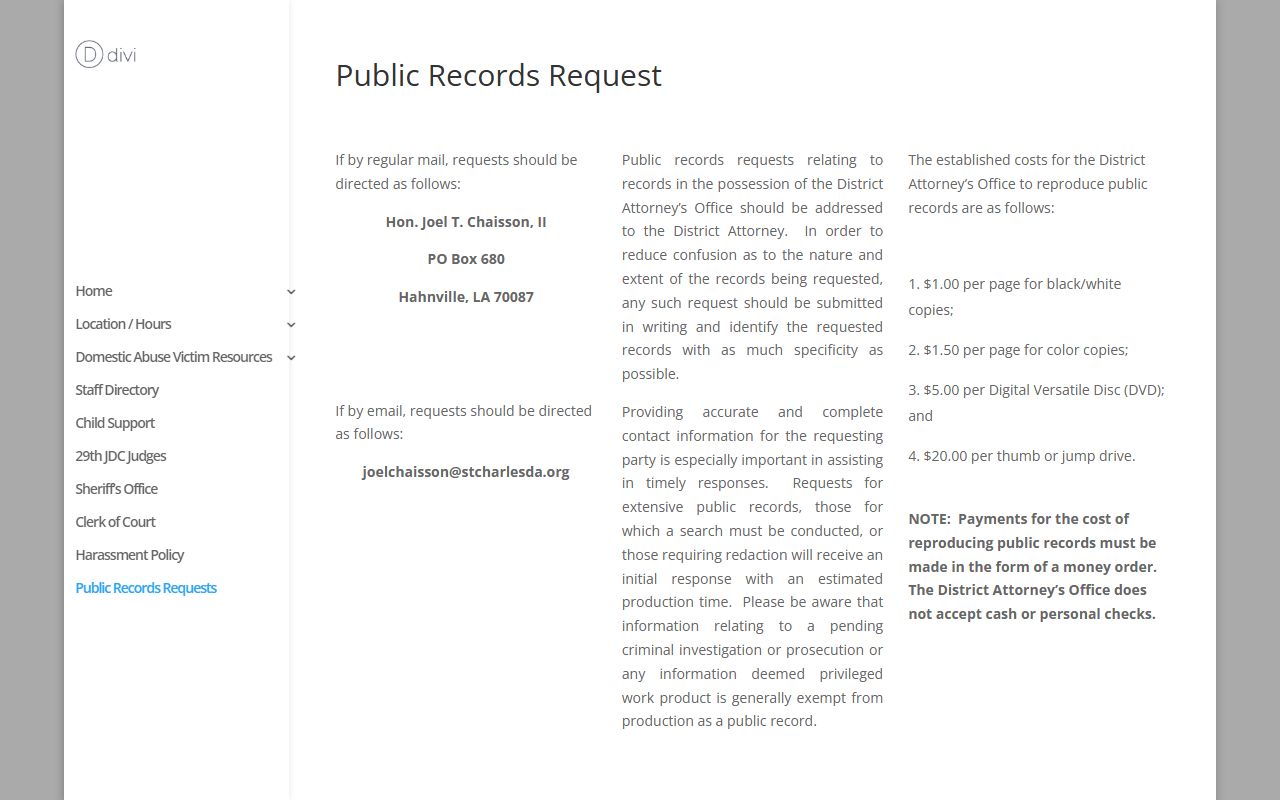
Keep the request channel matched to the office: DA records through the DA, court-file records through the Clerk, and jail booking information through Nelson Coleman or the Sheriff.
Background Check Considerations
Casual court-record searches are not the same as compliant background checks. A court file may include pending charges, dismissed counts, amended counts, and records that require legal interpretation. For credit, employment, tenant screening, insurance, or similar uses, use a legally compliant consumer-reporting process rather than copying public-record snippets into a decision file.
Important: This website is not a consumer reporting agency and court or jail information here may not be used for FCRA-covered decisions.
Restricted Court Records After an Arrest in St. Charles Parish
Some records remain outside ordinary public access even when an arrest happened. Louisiana public-records law recognizes exemptions for pending investigations and prosecutions, juvenile records, sexual-offense victim identifiers, confidential sources, undercover-officer identifiers, investigative techniques, security procedures, and privileged work product. The Sheriff's public-records page also states that criminal offense records beyond an initial report are generally privileged until adjudicated.
When a search does not show a case, that may mean the DA has not filed yet, the matter is sealed or juvenile, the online search did not expose the record, the person is held for another agency, or the booking was under a different name or date. Use the Clerk, DA, and Nelson Coleman contacts together before assuming that no record exists.